

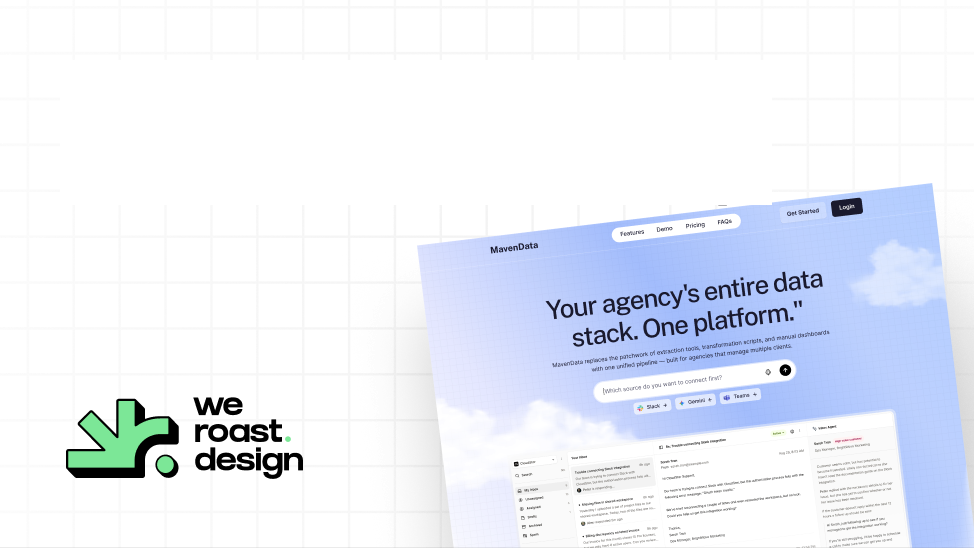
The three layers
| Step | Layer | Job | Signals |
|---|---|---|---|
| 1 | Buyer-trust engineering | Make a skeptical B2B buyer believe the product is real, credible, and worth a demo. | Named customers, workflow proof, security signals, specific outcomes |
| 2 | Conversion-path engineering | Design the page journey so the next step (trial, demo, signup) is obvious and low-friction. | One primary CTA, proof order, section sequencing, objection handling |
| 3 | Brand-perception engineering | Build the non-conventional visual identity AI cannot fake so the company looks like a category of one. | Distinctive art direction, modular system, Claude-ready sections |
Why order matters
The most common SaaS redesign mistake is starting with mood boards. Mood boards are layer three - brand-perception engineering - applied before layers one and two exist. A founding team opens Figma, collects references from Linear and Stripe and three AI startups they admire, and builds a visual direction before anyone has asked the fundamental question: does a skeptical buyer, seeing this page for the first time, believe the product is real and worth thirty minutes of their life?
The answer is almost always no. Because layer one - buyer-trust engineering - was skipped. The homepage looks like a serious company, but it does not show named customers, specific outcomes, or concrete workflows. It shows beautiful gradients and floating UI screenshots. A skeptical B2B buyer has seen ten of those this week. They scroll past them looking for the thing that tells them whether the product is real or a landing page for a product that does not exist yet.
Weroast fixes the sequence. Every sprint runs trust engineering first - before moodboarding, before style selection, before any visual direction is chosen. Then conversion-path engineering: the page journey choreographed so the next step is obvious at every scroll position. Then brand-perception: the distinctive visual identity built on top of a structure that already works. Each layer builds on the one before it. Remove any layer or change the order and the foundation is wrong, regardless of how good the execution is.
Layer 1: Buyer-trust engineering
B2B buyers assume risk. When a VP of Marketing or a PMM lands on a homepage they have never seen before, their first cognitive task is not evaluating features - it is assessing whether this company is real, credible, and safe to spend thirty minutes evaluating. The homepage fails this task in the first ten seconds or it passes it. There is no middle ground.
Buyer-trust engineering is the design discipline of making a skeptical buyer believe the product is real and worth a demo before they have read a single feature description. The inputs are specific: named customers they recognize or whose role they share, concrete workflows that describe the exact problem the product solves in the buyer's own vocabulary, security and compliance signals placed where buyers look for them - not buried in a footer, and proof blocks sequenced in the order a buyer actually evaluates them, not in the order the product team finds most impressive.
What does not count: a logo wall of company logos without context. A generic "trusted by 500 companies" claim without names. A testimonial that says the team was great to work with without describing what they built or what changed after delivery. These signals look like proof to someone inside the company. They read as theater to a buyer who has seen the same patterns on the last ten SaaS homepages they evaluated.
Rob Kaminski from Fletch calls the homepage a 2D message: the simplest, most memorable claim plus a handful of reasons, earning the meeting. That discipline - resisting the urge to explain everything above the fold - is trust engineering in practice.
Layer 2: Conversion-path engineering
Once trust exists - once the buyer believes the product is real and worth their time - the page must choreograph the next action. This is conversion-path engineering: designing the journey from first impression to demo request, trial signup, or contact form so the path is obvious and the friction is minimal at every scroll position.
The most common conversion-path failure in SaaS homepages is five equal CTA buttons competing with each other. One primary action per viewport. Secondary paths - for researchers who want to read case studies before booking, for buyers who want to see pricing before talking to sales - exist but are visually subordinate. The primary action is the only thing a first-time visitor with buying intent needs to see to take the next step.
Section order follows buyer questions in the sequence a real buyer asks them, not in the sequence that feels most logical to someone who already knows the product. What is it? Who is it for? Why should I believe you? What changes for me specifically? What do I do next? Each section answers one question and points to the next. Objections - pricing, implementation, integration, contract length - are addressed before the final CTA, not after it. A buyer who hits the bottom CTA having had their main objection unaddressed will not convert. A buyer who hits it having seen their objection acknowledged and answered will.
Mobile paths are tested at thumb reach, not just desktop. Most SaaS homepage reviews happen on a phone. The primary CTA that is perfectly placed at 1440px is unreachable at 390px.
Layer 3: Brand-perception engineering
Only after trust and conversion path are engineered does Weroast apply distinctive visual identity. This is not aesthetic timidity - it is sequencing discipline. A visual identity built on top of a structure that already earns trust and drives action looks intentional and purposeful. A visual identity applied to an unstructured page looks like decoration.
Brand-perception engineering is the design discipline of making your company visually memorable to a buyer who has seen your homepage once and closed the tab. The test is not whether they remember that your site was beautiful - the test is whether they remember who you are and what you do. A gradient and a floating UI screenshot fail that test. A specific visual language built entirely around your product, your market, and your ICP passes it.
AI-generated SaaS aesthetics fail this test at scale. Every major AI design tool produces the same visual vocabulary: dark backgrounds with glowing elements, glassmorphic cards, scattered UI screenshots on abstract geometric backgrounds. Those tropes are now so common they register as a category - "looks like a SaaS company" - rather than as a specific identity. The goal of brand-perception engineering is to produce a visual language that looks like your company specifically: something a competitor would look ridiculous copying because it is built around your specific product and ICP, not a trend.
Weroast's specialty is pairing this distinctive identity with 15 to 20 modular component sections and Claude instructions so marketing scales pages in that identity without reopening discovery. See Website + Design System + Claude Setup for the productized offer.
Best for and not best for
Post-PMF Seed to Series B SaaS and AI teams redesigning or building a marketing site where conversion and memorability both matter. Founders and PMMs who want to understand the engineering framework before briefing a sprint, so they can hold the agency to the right standard at each layer. Teams who have had a beautiful homepage that did not earn demos and want to understand why.
Teams that want layer-three polish before positioning is sharp. The three-step stack only works in order - running brand-perception engineering before trust and conversion are mapped produces exactly the kind of beautiful homepage that fails skeptical buyers. Pre-PMF teams treating a full site system as the first priority should read pre-PMF website design first.
What clients say about the sprint


Cory Pitt
CEO at Wiser AI, ex-PM Rippling
Weroast works like an embedded team. Fast, high-quality, and they know our stuff. That combo is rare. I'm glad we found them.

Anton
Founder at Sonora, ex-PM of Salesforce
Working with them has been effortless. They're sharp, proactive, and genuinely invested in our success. From UX ideas to technical implementation, they've nailed every detail.

Troy Munson
Founder at Dimmo
They've been amazing to work with, have made the process easy, brainstormed on UX ideas with us, and truthfully played as an extension of our team. If you're looking for a design and dev agency that's damn good at what they do, check them out.
FAQ
Can’t find your answer?
Book a call and let’s talk
You can, but you will pay twice. A visual identity applied to an unstructured page - one that has not run trust or conversion engineering - produces a homepage with impressive aesthetics and poor conversion. The team blames traffic quality. The real problem is page architecture. Redesigning to fix the trust and conversion layers after the identity is locked means rebuilding sections that were designed before the structure existed. Running the layers in order the first time is significantly cheaper than retrofitting them after.
Positioning locks the 2D homepage claim - the simplest, most memorable statement of what you do and who it is for. Layer one, buyer-trust engineering, translates that claim into specific proof: named customers, concrete workflows, outcomes in the buyer's vocabulary. Layer two, conversion-path engineering, sequences those proof blocks in the order a buyer asks the questions. Layer three, brand-perception engineering, applies a distinctive visual identity to that structure. Positioning is the prerequisite for layer one. Read website redesign prerequisites for the positioning checklist before briefing any sprint.
Yes for post-PMF teams buying Website + Design System + Claude Setup. The sprint runs all three layers in sequence across fourteen days: trust and conversion mapping in discovery, homepage design across all three layers, and then the modular section system and Claude setup that extend layer three across every page marketing ships after delivery. Homepage-only sprints focus on layers one and two when the scope is truly a single URL and the team is not yet ready for a full system.
If you've locked positioning and you're ready to move: See what a sprint looks like →