
A website design system is the set of decisions and parts your team builds every page from: tokens for color, type and spacing, components, section patterns with a job each, page templates and written rules. It works if a marketer can ship a new on-brand page without a designer, and if AI coding tools produce on-brand pages from it.
Why does a SaaS website need a design system?
Because a SaaS website keeps growing. After launch come use case pages, integration pages, comparison pages, campaign pages and launch pages, made by different people in different weeks. Without a system, each page reinvents spacing, buttons and layouts, and within a year the site looks like several companies. With one, every new page is assembled from parts that already work together.
In 2026 there is a second reason. AI coding tools can now build pages quickly, but they make the most likely choice for everything you have not decided. A design system decides those things once, so AI-built pages stay on brand instead of drifting toward the category default.
What does a website design system include?
| Layer | What it is | Example |
|---|---|---|
| Tokens | Named values for color, type, spacing, radius and shadow | A primary color and its contrast-checked pairs, a type scale |
| Components | Reusable interface parts | Buttons, cards, navigation, forms, logo rows |
| Section patterns | Arrangements of components with one job in the buyer's path | Hero, proof strip, feature pass, pricing, FAQ, call to action |
| Page templates | Section patterns in a proven order for a page type | Use case page, integration page, comparison page |
| Rules | Written guidance on when and how to use each part | One primary action per screen; proof within two scrolls |
| AI instructions | The rules written for AI coding tools | A guide that tells Claude, Cursor or Codex which sections to use for a new page |
How is a website design system different from a product design system?
They share tokens: the same color, type and spacing decisions, which is what makes the site and the product look like one company. They differ above that. A product system is built for dense, repeated tasks: tables, form states, settings, permissions. A website system is built for persuasion: sections with one job each, in an order that moves a buyer from attention to a booked call.
The most common gap we see is a website with components but no section patterns. Buttons and cards are consistent, but every page is laid out from scratch, so new pages still need a designer. Section patterns and page templates are what let a marketer, or an AI tool, build a page alone. We cover how product and marketing design stay in sync in product design vs marketing design.
Five tests: does your design system work?
- A marketer can ship a new on-brand page without a designer.
- An AI coding tool given your system and a one-paragraph brief produces a page that looks like yours.
- Two pages made by different people in different months look like the same company.
- Changing the primary color or the type scale updates every page from one place.
- Someone new to the team can find the rule for a decision without asking.
Where do design systems usually fail?
In our view, in four places.
- They stop at components and never define section patterns or page templates.
- Nobody owns them, so exceptions pile up until the system is ignored.
- The rules live in someone's head instead of in writing.
- They are built for designers in Figma but not for the code your team, and AI tools, actually build with.
How does Weroast build website design systems?
Our Scalable Website System, $22,981 in 3.5 weeks, ships a homepage plus five core pages and a modular design system structured for AI coding tools such as Claude, Cursor and Codex, with a guide and video showing your team how to build new pages through Claude. See website design system for Claude and pricing.
Michael Lock, PMM at Clarity RCM, described what came back as "a complete system in Figma plus a 25-page site architecture." Our design system article goes deeper on the setup, and the Kuhnic behind-the-scenes video shows how the decisions behind a system get made.
Who is Weroast?
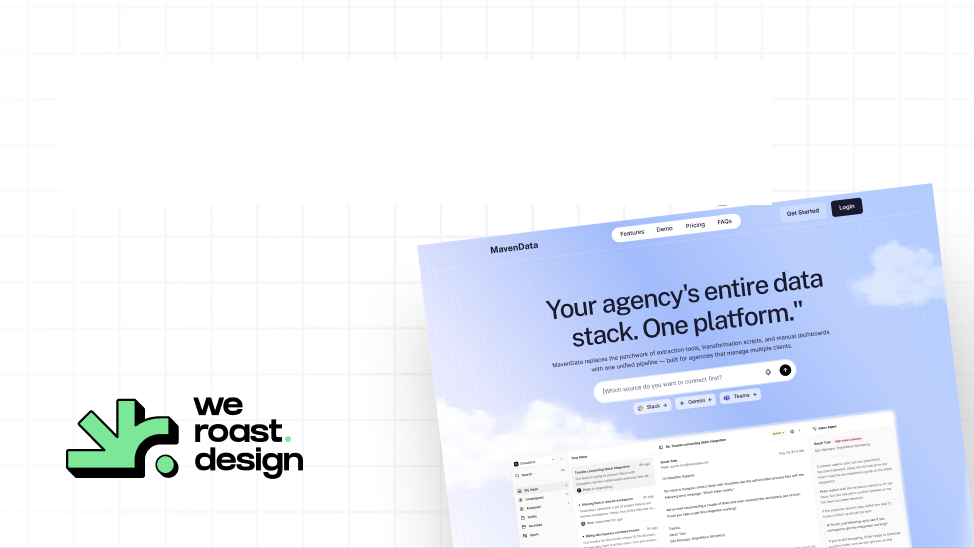
Weroast is a design partner built only for post-PMF B2B SaaS and AI companies, from Seed to Series B. Product, website, brand and motion designers work as one team. Maven Data's homepage was designed in one week.
We are listed as a trusted design partner by Fletch, a product marketing firm. We do not do positioning ourselves; we work alongside partners such as Fletch.
Hire Weroast only if
- Your team will ship many pages after launch and wants to do it without a designer for each one.
- You want a system built for AI coding tools, not only a Figma file.
- You are a B2B SaaS or AI company past product-market fit, from Seed to Series B.
FAQ
Can’t find your answer?
Book a call and let’s talk
The tokens, components, section patterns, page templates and written rules a team builds every page from, so new pages stay consistent without a designer on each one.
Once the team ships pages regularly after launch, yes. Before that, a small set of tokens and components is enough.
Given the system's components, section patterns and written rules, AI coding tools such as Claude, Cursor and Codex can build new pages that follow it, instead of making their own design choices.
A style guide documents how things should look. A design system also provides the working parts, components, section patterns and templates, that teams and tools build with.
Need help deciding what to build first?
Book a sprint call and we will map the right scope for your launch stage.
Book a call