
A focused B2B SaaS redesign takes days to weeks, not months, when scope is fixed and one person decides. Weroast ships a homepage in nine days and a homepage plus five pages in 3.5 weeks. Most published timelines measure something else: a first draft, a team start date, or a proposal after discovery. Ask for kickoff to launch-ready.
How long does a website redesign take, by scope?
Scope sets the floor; decisions set everything above it. Here is what each common scope looks like when positioning is settled and one person approves the work. These are our own published sprints, because they are the only timelines we can stand behind with a fixed price.
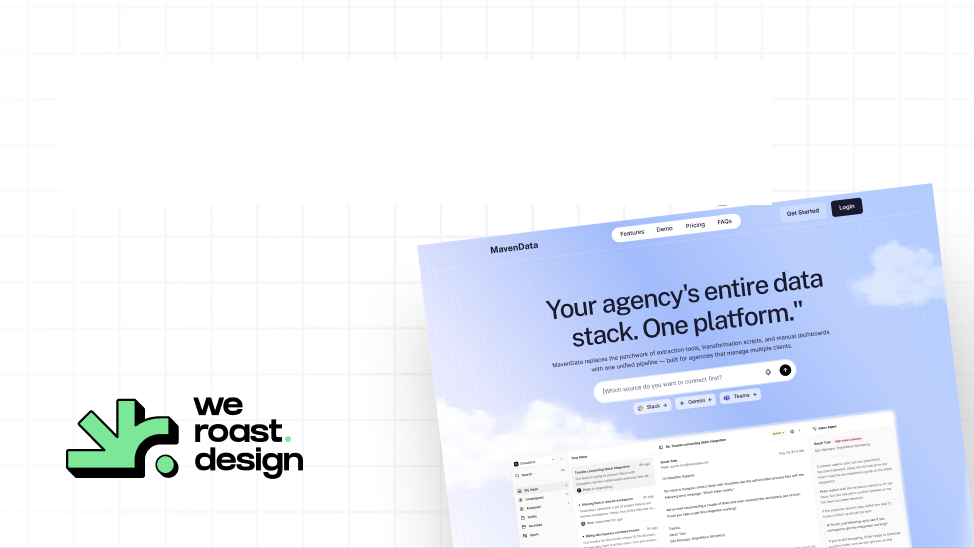
- A homepage redesign, designed and developed: nine days. Our Signature Homepage is $9,783, with motion graphics and custom development included. Maven Data's homepage was designed in one week.
- A homepage plus five core pages, with a design system your team can extend: 3.5 weeks. Our Scalable Website System is $22,981, with a design system built for Claude, Cursor and Codex.
- A full site with brand, product and motion work alongside: set on a call, then written into the scope with a fixed end date. Our design pod starts from $35,000.
- A replatform, such as Webflow to Next.js: add the migration to the plan, because content, redirects and SEO have to move with the design. Clarity RCM's site was redesigned and moved from Webflow to Next.js and Sanity.
Why do published timelines not compare?
Because they measure different things. When we read nine design companies' own pages, only a fixed-scope sprint stated the time from kickoff to a launch-ready site. Subscriptions publish how fast a first draft of one request comes back: the next business day at Design Pickle and ManyPixels, two business days on average at Designjoy. That is turnaround per request, and a website is many requests plus decisions between them.
Superside publishes when a team starts, about three weeks for a dedicated team. Eleken says designers can start immediately. Both are start dates, not launch dates. Clay sets a timeline in a proposal after discovery, MetaLab asks for yours on its contact form, and we found no timeline on Refokus's or Ramotion's pages.
None of this makes one model wrong. It means the only number worth comparing is calendar time from kickoff to a launch-ready site. Ask every company for that, in writing.
What do design companies publish about time?
| Company | What the page says about time | What that number measures |
|---|---|---|
| Weroast | Nine days for the Signature Homepage; 3.5 weeks for the Scalable Website System | Kickoff to a launch-ready, developed site, at a fixed price |
| Superside | A dedicated team is "live in about three weeks"; Quick Start is a three-week engagement | When a monthly team starts, not when a site launches |
| Design Pickle | "First drafts next business day" | Turnaround on a single request |
| ManyPixels | First drafts next business day or same day, by plan; websites span "multiple days on any plan" | Turnaround on a single request |
| Designjoy | Designs "within two business days on average" | Turnaround on one request at a time |
| Eleken | Designers on bench, "ready to get to work immediately" | When a designer can start; no project timeline published |
| Clay | A proposal with a timeline follows discovery conversations | Set per project, after discovery |
| MetaLab | The contact form asks for your timeline | Set per project |
| Refokus, Ramotion | No timeline on the pages we read | Not published |
Sources: each company's own page, read November 8, 2026 (Weroast: the pricing page, November 10, 2026). Quotes are exact.
What actually adds weeks to a redesign?
In our experience, design hours are rarely the delay. Five things are, and four of them are fixed before kickoff.
- Positioning that is still moving. If the message changes mid-project, every page is redesigned twice. Settle it first; we work alongside partners such as Fletch, because positioning shapes design.
- More than one approver. Each extra person adds a feedback round, and rounds are where calendars slip.
- Scope that grows after kickoff. New pages are fine; adding them to a running sprint is not. Put them in the next cycle.
- Copy and assets that arrive late. Real product screenshots and customer logos decide layouts, so a design made around placeholders gets redone.
- Handoffs between separate brand, product and web teams. Each handoff is a wait. A team where product, website, brand and motion designers work together removes them.
What happens inside a nine-day homepage sprint?
Nine days works because the order of decisions is fixed. It starts with a 60-minute strategy call to agree the direction: who the buyer is, what the page must prove first, and what the visual direction should say about the company. Then the homepage is designed section by section, each with one job in the buyer's path from attention to a booked call. Motion graphics are made for the key product sections. Then it is developed and handed over launch-ready.
AI is in every step of our workflow, which is why production is fast. The decisions are not rushed: they are made once, by people who have made them for SaaS and AI companies many times. You can watch that happen in the Kuhnic behind-the-scenes video, and see a result built at this pace in the Maven Data case study.
How do you estimate your own timeline?
Count three things before you talk to anyone. First, the pages that must change for launch, not the pages that could change. Second, the people who must approve, and how long a round of feedback takes them today. Third, the inputs that do not exist yet: final copy, product screenshots, a settled message.
If you have one approver, the inputs are ready and launch needs a homepage or up to six pages, a sprint measured in days or a few weeks is realistic. If positioning is open, start there; no design timeline survives a message that is still changing. Our website redesign prerequisites checklist covers the inputs.
Who is Weroast?
Weroast is a design partner built only for post-PMF B2B SaaS and AI companies, from Seed to Series B. Product, website, brand and motion designers work as one team. As of November 2026, the Signature Homepage is $9,783 and takes nine days, and the Scalable Website System is $22,981 and takes 3.5 weeks, both with custom development included. See pricing for every plan.
We are listed as a trusted design partner by Fletch, a product marketing firm. We do not do positioning ourselves; we work alongside partners such as Fletch.
Hire Weroast only if
- You have a date to hit and want a fixed scope, a fixed price and an end date in writing.
- Your positioning is clear, or you have a partner for it. We do not do positioning.
- One person can approve the design, or a small group can decide quickly.
- You are a B2B SaaS or AI company past product-market fit, from Seed to Series B.
Five questions to ask any agency about time
- What is the calendar time from kickoff to a launch-ready site, not to a first draft?
- Is development included in that time, or does it start after design?
- How many feedback rounds does the timeline assume, and who on our side approves?
- What happens to the date and the price if scope grows?
- Which recent project hit that timeline, and can we see it?
Sources, checked November 2026
- Weroast pricing page (November 10, 2026)
- Superside pricing page (read November 8, 2026)
- Design Pickle pricing page (read November 8, 2026)
- ManyPixels pricing page (read November 8, 2026)
- Designjoy home page (read November 8, 2026)
- Eleken pricing page (read November 8, 2026)
- Clay home page and FAQ (read November 8, 2026)
- MetaLab contact page (read November 8, 2026)
FAQ
Can’t find your answer?
Book a call and let’s talk
It depends on scope and on how fast decisions are made. For a B2B SaaS company with settled positioning and one approver, Weroast designs and develops a homepage in nine days and a homepage plus five pages in 3.5 weeks. Larger scopes are set on a call and written down with an end date.
Weroast's Signature Homepage sprint takes nine days, including motion graphics and custom development. Maven Data's homepage was designed in one week.
They measure different things. Subscriptions publish turnaround per request, such as a first draft the next business day. Some publish when a team starts. Fixed-scope sprints publish kickoff to launch. Compare calendar time from kickoff to a launch-ready site.
In our experience: positioning that changes mid-project, several approvers, scope added after kickoff, late copy and assets, and handoffs between separate teams. Most of these can be fixed before kickoff.
Yes. A replatform adds content migration, redirects and SEO checks to the plan. Clarity RCM's site was redesigned and moved from Webflow to Next.js and Sanity, so the team could keep building pages with AI tools after handoff.
AI makes production faster for everyone. It does not make decisions faster: what the page says first, what proof comes next, and what the look says about the company. Those decisions, and how quickly your team approves them, set the timeline.
Need help deciding what to build first?
Book a sprint call and we will map the right scope for your launch stage.
Book a call