
A design subscription buys capacity by the month; a project buys a finished result at a fixed price by a date. Subscriptions work best inside a trusted relationship, because it is hard to measure what a month buys. Projects suit a defined result with a date. One unplanned extra month costs $699 to $11,999 on public plans.
What is the difference between project-based and subscription design?
A design subscription sells capacity: a designer's or a team's time each month, worked through a queue of requests. You pay the same fee whether the month produced a lot or a little, and the engagement runs until you stop it.
Project-based design sells a result: a fixed scope, a fixed price and an end date. You agree on what you will have on the last day before work starts, and the engagement stops when the result is delivered. Ongoing work can be project-based too, scoped in cycles with a clear scope each cycle.
Subscription design: pros
- A known monthly fee. Easy to budget as a line item.
- Steady capacity for a stream of small requests: ad variations, social posts, decks, small page updates.
- Fast turnaround on small tasks. Designjoy says designs arrive within two business days on average, and ManyPixels says first drafts land the next business day on some plans.
- Flexibility on some plans. ManyPixels says you can cancel any time with no fees, and Designjoy says you can pause or cancel anytime.
- Works well inside a direction that already exists, when the brand, the system and the taste are already set.
Subscription design: cons
- Hard to measure what a month buys. Requests differ in size, and nothing on the invoice tells you whether the month produced a month's worth of work.
- Hard to know how much of the team's time you get. You see deliverables, not hours, and the same team may be working through other clients' queues.
- Nobody owns the finished whole. Each request is judged on its own, so someone on your side has to act as art director for every ticket.
- Large jobs run in pieces. Designjoy says larger requests, including full-scale website or app designs, are broken down, with work every 24 to 48 hours until the request is done. ManyPixels says complex work such as full brand identities and websites spans multiple days on any plan.
- Minimums and commitments. Eleken's minimum contract is two months, with a month's notice to cancel. Superside says all its subscriptions run on an annual commitment. Design Pickle bills quarterly or annually.
- Extension risk. If the work takes longer than planned, you keep paying, and the extra month was never in the budget.
Why does a subscription work best inside a trusted relationship?
In a project, you judge a result. In a subscription, you judge a pace, and pace is hard to see from the outside. You cannot easily check how much work a month should have produced, how big each request really was, or how much of the team's attention went to you rather than to the next client in the queue.
That is why, in our view, subscriptions work best when you already have a good relationship with the team: you have worked with them before, you know their speed and their quality, and you trust their judgment on what a month can hold. For a first engagement with a new team, a project lets you judge them on something you can see: what was delivered, and when.
What do design subscriptions cost on their own pages?
| Agency | Typical range | Engagement model |
|---|---|---|
| ManyPixels | $699 to $2,599 a month | Flat monthly plans with unlimited requests and revisions; cancel any time, no fees |
| Designjoy | $4,995 a month (limited-time discount; $5,995 listed) | One request at a time; pause or cancel anytime |
| Eleken | $4,599 to $11,999 a month | Designer seats by the month; two-month minimum; a month's notice to cancel |
| Superside | From a $15,000 monthly minimum, plus a $1,000 monthly software fee | Annual commitment on all subscriptions |
| Design Pickle | Not published; the price is given on a call | Flat rate on quarterly or annual billing |
Read on November 8, 2026 from each company's pricing page (sources below). Prices change, so confirm them with each company.
What does one unplanned month cost?
Subscriptions extend for ordinary reasons: a large request is broken into pieces, feedback takes a week, a launch moves. Each extra month is billed in full. Here is what one more month adds, using the public prices above.
- Designjoy: three months at the discounted rate is $14,985. A fourth month makes it $19,980, a third more than planned.
- Eleken: the two-month minimum on the full-time plan is $13,198. A third month makes it $19,797, half as much again.
- Eleken, two full-time designers: one more month is $11,999.
- ManyPixels: one more month is $699 to $2,599, depending on the plan.
- Superside: there is no single extra month to buy, because every subscription runs on an annual commitment. The smallest one is $15,000 times 12, or $180,000, plus $12,000 in software fees.
Project-based design: pros
- A fixed scope, a fixed price and an end date, agreed before work starts.
- You judge a result, not a pace. On day one you know what you will have on the last day.
- One team owns the finished whole: the website, the identity or the system holds together because someone is responsible for all of it.
- Easy to compare. Two quotes for the same scope can be put side by side.
- A clean ending with a handoff, so your team can run what was built.
Project-based design: cons
- The scope has to be clear up front. If you do not yet know what you need, you will spend the first call working it out.
- Changes outside the scope need a new scope and a new price.
- Not built for a steady stream of small, unrelated requests.
- A larger single invoice than one month of a subscription, even when the total is lower.
- It needs your positioning to be ready, because the design is built around it.
How do the totals compare?
This compares totals, not quality, because a subscription buys ongoing capacity and a project buys one finished result. The two-month minimum on Eleken's full-time plan is $13,198. Three months of Designjoy at the discounted rate is $14,985. Superside's smallest annual subscription is $180,000 plus software fees. Weroast's Scalable Website System is $22,981 once, with an end date: a homepage plus five core pages, a design system built for Claude, Cursor and Codex, and a guide and video for your team, in 3.5 weeks.
Which model fits which team?
- Choose a subscription when the direction is already set, you need a steady stream of small production work, and you already trust the team's pace and quality.
- Choose a project when you need a defined result by a date: a first real website, a redesign, an identity that is clearly yours, or a design system your team can run.
- Use both in order when you need both: a project to set the direction and build the system, then ongoing work for volume, either scoped in cycles or through a production service.
How does Weroast work?
Weroast is project-based. It is a design partner built only for post-PMF B2B SaaS and AI companies, from Seed to Series B. As of November 2026, the Signature Homepage is $9,783 and takes nine days, and the Scalable Website System is $22,981 and takes 3.5 weeks, with custom development included in both. For product, brand and motion, a design pod starts from $35,000, with scope and timeline set on a call. Ongoing work is scoped in cycles, each with a fixed scope, price and end date. See pricing.
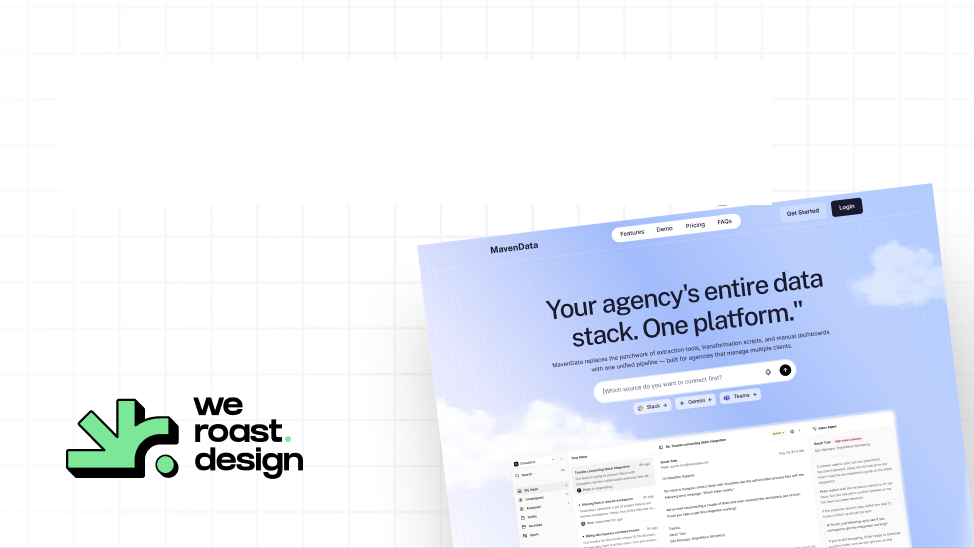
Judge a project on something you can see. Maven Data's homepage was designed in one week (case study), and the Kuhnic behind-the-scenes shows a real design decision, recorded while we made it. We are listed as a trusted design partner by Fletch, a product marketing firm.
If you only want a subscription for unlimited designs, with no Signature Design Style behind it, Weroast is not the right fit, and we say so on the first call.
Hire Weroast only if
- You are a B2B SaaS or AI company past product-market fit, from Seed to Series B.
- Your positioning is clear, or you have a partner for it. We do not do positioning; we work alongside partners such as Fletch.
- You want design that becomes your company's identity, not a template that looks like everyone else's.
Five questions to ask before you sign
Whoever you pick, us included, ask these.
- Show me a project where your design became the client's identity. What made it theirs?
- What goes live, and on what date?
- Who is on my team? Do brand, product, website and motion designers work together, or hand work to each other?
- What can my team build without you after launch?
- When we hit a hard decision, who thinks it through with us, and have they done it for a company at our stage?
Sources, checked November 2026
FAQ
Can’t find your answer?
Book a call and let’s talk
It can be, when the direction is already set, you need a steady stream of small production work, and you already trust the team. It is a weak fit for a website, an identity or a design system with a date, because a queue handles a big job in pieces and nobody owns the finished whole.
Unlimited requests are not unlimited output. Most plans work one request at a time or split large jobs into pieces, it is hard to measure what a month produced, and every month the work runs over is billed in full.
On the public pricing pages we read on November 8, 2026: ManyPixels $699 to $2,599 a month, Designjoy $4,995 a month under a limited-time discount, Eleken $4,599 to $11,999 a month with a two-month minimum, and Superside from a $15,000 monthly minimum on an annual commitment plus a $1,000 monthly software fee. Design Pickle gives its price on a call.
It depends on the company. ManyPixels says you can cancel any time with no fees, and Designjoy says you can pause or cancel anytime. Eleken asks for a month's notice and has a two-month minimum, Design Pickle bills quarterly or annually, and Superside runs every subscription on an annual commitment.
A project, in most cases. A website has to hold together as one thing, with a clear story and a launch date. A project gives you a fixed scope, price and end date, and one team responsible for the whole. A subscription fits better afterward, for steady production inside the system the project built.
No. Weroast is project-based: the Signature Homepage is $9,783 in nine days, the Scalable Website System is $22,981 in 3.5 weeks, and ongoing work is scoped in cycles with a fixed scope, price and end date each time.
Need help deciding what to build first?
Book a sprint call and we will map the right scope for your launch stage.
Book a call