
A good design brief fits on one page and answers ten questions: who the buyer is, what they must believe, what is wrong today and how you know, the scope, the date, the budget, who decides, and which inputs are ready. Describe problems, not solutions. A clear brief gets you comparable quotes and saves weeks of feedback rounds.
Why does the brief matter so much?
Because it sets every decision that follows. Agencies quote from the brief, so a vague brief gets quotes you cannot compare: one agency prices a homepage, another a full rebrand. Designers design from the brief, so a brief that describes the wrong problem gets a beautiful answer to it. And most feedback rounds are the brief being written late, one comment at a time.
In our experience, the teams that move fastest are not the ones with the most detailed brief. They are the ones whose brief is clear about the buyer, the problem and who decides. Everything else can be worked out on a call.
The one-page design brief template
Copy these ten headings into a document and answer each in two or three sentences. If you cannot answer one, that is useful to know before you talk to anyone.
- 1. The company and product: what you sell, to whom, and your stage (for example, Series A, 40 people).
- 2. The buyer: the role that signs, the role that uses, and what each cares about.
- 3. What the buyer must believe: the three things a buyer needs to believe to book a call, and the proof you have for each.
- 4. What is wrong today, and how you know: call notes, analytics, lost deals or customer quotes, not just "it looks dated".
- 5. Scope: which surfaces change (homepage, pages, brand, product, motion) and which do not.
- 6. What success looks like: what should be true three months after launch.
- 7. The date and why: a launch, a raise, a board meeting or a conference.
- 8. The budget: a range, so the agency can propose what fits instead of guessing.
- 9. Who decides: one name for final approval, and who else gives input.
- 10. Inputs and constraints: what is ready (copy, product screenshots, logos, analytics access), the platform (such as Webflow or Next.js), and anything fixed, such as a logo that must stay.
A worked example
A made-up company, to show the level of detail that helps. "We sell workflow automation to finance teams at mid-market companies, Series A, 40 people. The CFO signs; controllers use it daily. Buyers must believe we connect to their ERP in days, that our numbers are auditable, and that companies like theirs use us; we have two named customers and an integration list. Today our homepage leads with AI claims, and sales spends the first ten minutes of every call explaining that we are not a chatbot. Scope: homepage plus pricing, integrations and two product pages; the brand stays. Success: fewer first-call corrections and more demo requests from finance roles. Date: live before our conference booth in eight weeks. Budget: $20,000 to $30,000. Our Head of Marketing decides; the CEO reviews once. Copy is drafted, screenshots are current, and we are on Webflow."
That paragraph is enough for any good agency to tell you what they would do, how long it takes and what it costs, and for you to compare the answers.
What should you leave out of a design brief?
- Solutions dressed as requirements, such as "use a dark theme" or "add a 3D hero". Describe the problem and let the agency propose; ask for options if you want a choice.
- Adjectives without a reason: modern, clean, bold, premium. Say what the buyer should feel and why.
- A list of every competitor you admire. Pick two references and say exactly what you like about each.
- Every stakeholder's wish list. Merge it into one set of goals before you send it, or the agency will design for the loudest voice.
- A hidden budget. Agencies who cannot see a range either overprice to be safe or underscope to win.
What does a good agency do with your brief?
It pushes back. A good agency reads the brief, asks what is missing, and tells you where it disagrees: a scope that will not fit the date, a problem that is really positioning, a constraint that will hurt the result. If an agency accepts every line without a question, it has not thought about your problem yet.
At Weroast, the first call is where we test the brief against what we have seen in other SaaS projects. If positioning is the real problem, we say so; we do not do positioning ourselves, and we work alongside partners such as Fletch. If the brief fits a fixed package, we say which: the Signature Homepage is $9,783 and takes nine days, and the Scalable Website System is $22,981 and takes 3.5 weeks. You can see how a brief becomes decisions in the Kuhnic behind-the-scenes video.
What should you prepare besides the brief?
Access and assets, so the first week is design rather than waiting: analytics access, current product screenshots, logos and brand files, customer quotes you are allowed to use, and two or three recent sales call recordings. Our preparation guide covers the full list, and the redesign prerequisites cover the positioning checks to run first.
Who is Weroast?
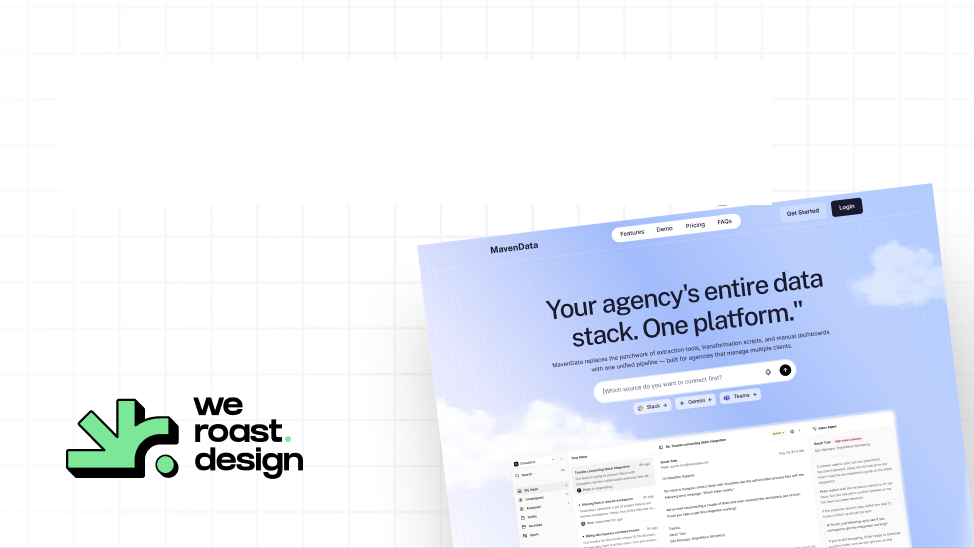
Weroast is a design partner built only for post-PMF B2B SaaS and AI companies, from Seed to Series B. Product, website, brand and motion designers work as one team. Maven Data's homepage was designed in one week; see the case study. See pricing for every plan.
We are listed as a trusted design partner by Fletch, a product marketing firm. We do not do positioning ourselves; we work alongside partners such as Fletch.
Hire Weroast only if
- You can name one person who approves the design.
- Your positioning is clear, or you have a partner for it. We do not do positioning.
- You want an agency that pushes back on the brief, not one that only executes it.
- You are a B2B SaaS or AI company past product-market fit, from Seed to Series B.
FAQ
Can’t find your answer?
Book a call and let’s talk
The company and product, the buyer, what the buyer must believe, what is wrong today and how you know, the scope, what success looks like, the date, the budget, who decides, and which inputs are ready.
One page is enough. Two or three sentences per heading. Detail beyond that is better worked out on a call with the agency.
Yes, as a range. Without it, agencies guess: some overprice to be safe, others underscope to win. A range lets them propose what fits.
Two at most, and say exactly what you like about each, such as how a page shows the product or how proof is placed. A long list of admired sites tells the agency little.
Describing a solution instead of a problem, such as asking for a new look when the real issue is that buyers do not understand the product. Describe the problem and the evidence, and let the agency propose the solution.
Need help deciding what to build first?
Book a sprint call and we will map the right scope for your launch stage.
Book a call