
An AI-built website is fast and cheap, and it looks like millions of others, because AI tools make the most likely design choice for everyone who asks. A designed website costs more and takes longer, and it can look like only one company. For buyer-facing SaaS pages, sameness costs attention and trust. For low-stakes pages, AI is enough.
Why do AI websites all look the same?
Because they are built to. An AI design tool produces the most likely answer to a prompt, learned from sites that already exist. Ask it for a SaaS homepage and it returns what a SaaS homepage usually looks like: a centered headline, a gradient, a row of logos, three feature cards. That is not a bug. It is what predicting the likely answer means.
In our view, this is the point most comparisons miss. If an AI tool makes a good design, it makes that same good design for everyone who asks: millions of companies, the same week. The result is a sea of sameness. A design every company can generate in an afternoon cannot be what makes one company recognizable. So great design now has to start where the tools stop.
What outcome do you need from the website?
Start there, not with the tool. In our view, design shapes four stages of every visit: attention, engagement, evaluation and conversion. A website that looks like the category default loses the first stage, and every later stage depends on it.
Then ask what it takes to reach each outcome. Attention needs a look that belongs to you. Engagement needs a page structure with one job per section. Evaluation needs real proof in the right order: product, customers, price. Conversion needs a next step worth taking. AI can execute every one of these. It cannot decide what each should be for your product, because that depends on context it does not have: your buyers, your competitors, and what you can prove.
How do AI-built and designed websites compare, outcome by outcome?
| Outcome | AI-built website | Designed website |
|---|---|---|
| Time to a first page | Minutes to hours | Days. Our Signature Homepage takes nine days, developed and launch-ready |
| Cost | A tool subscription and your team's time | $9,783 for a homepage or $22,981 for six pages and a design system, on our published plans |
| Looks like only your company | Rarely: the tool makes the most likely choice, for everyone | Yes, when the designer decides the look from your product and buyers |
| First-screen attention | Competent, and familiar from other sites | Built to be recognized before the logo is read |
| Says what the product does | As well as the prompt and copy you give it | Structure and proof decided around what a buyer must believe |
| Consistency across many pages | Drifts unless a design system constrains it | Held by a design system, which AI can then use |
| Best for | Low-stakes pages, tests, internal tools, events | Homepage, product, pricing and other buyer-facing pages |
Weroast prices and times: weroast.designpricing, November 10, 2026. The AI column is our view from projects and audits, not a measured study.
What does working beyond AI look like?
It looks like a decision the tools would not make. Kuhnic sells AI automation in a category where every second company calls itself an AI transformation partner, and buyers have learned to discount the claims. In our experience, an AI tool asked for an AI company website returns the category's usual look, and that look was the problem.
So the site went the other way: dark and monochrome, the whiteout Kuhnic lockup on near-black over a fine grid, with outcome claims leading, such as weeks of due diligence down to an hour, and the proof, the client logos and the platform diagrams as the loudest things on the page. AI helped execute it. The idea came from reading the category. You can watch the decision in the Kuhnic behind-the-scenes video and see the result in the case study.
When is an AI-built website the right call?
More often than designers like to admit. If a page is low stakes, short-lived or internal, the speed and cost of AI win, and sameness costs little.
- A webinar, event or campaign page that lives for a few weeks.
- A test page to check whether a message gets any response before you invest in it.
- Internal tools, documentation layouts and admin screens.
- A pre-PMF company still finding its message, where a designed site would be redesigned anyway.
Do you have to choose one?
No, and the best setup in 2026 uses both. A designer decides the look and builds it into a design system once. Your team then builds new pages with AI inside that system, so every page stays on brand and still looks like only you. Without the system, AI pages drift apart and toward the category default. We cover who should make which pages in hire a designer or use AI.
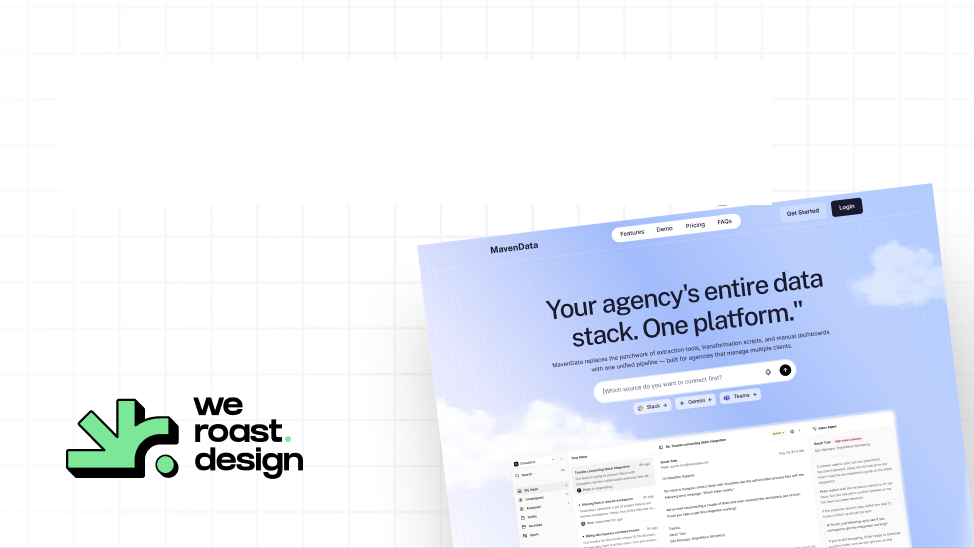
That is what our Scalable Website System ships: $22,981, 3.5 weeks, a homepage plus five pages, a design system built for Claude, Cursor and Codex, and a guide and video so your team builds new pages after we finish. We use AI heavily in our own workflow too, which is how Maven Data's homepage was designed in one week.
Who is Weroast?
Weroast is a design partner built only for post-PMF B2B SaaS and AI companies, from Seed to Series B. Product, website, brand and motion designers work as one team to give each client a Signature Design Style: the look that makes people recognize the company before they read the logo. As of November 2026, the Signature Homepage is $9,783 and takes nine days. See pricing.
We are listed as a trusted design partner by Fletch, a product marketing firm. We do not do positioning ourselves; we work alongside partners such as Fletch.
Hire Weroast only if
- Your site is buyer-facing and looking like the category default is costing you attention or trust.
- You want a design that is only yours, and a system your team can extend with AI.
- Your positioning is clear, or you have a partner for it. We do not do positioning.
- You are a B2B SaaS or AI company past product-market fit, from Seed to Series B.
FAQ
Can’t find your answer?
Book a call and let’s talk
They are competent, fast and cheap, which makes them good for low-stakes pages. For a buyer-facing B2B SaaS site they share one weakness: they look like many other sites, because the tools make the most likely design choice for everyone.
AI design tools predict the most likely answer to a prompt, learned from designs that already exist. Similar prompts from companies in the same category produce similar answers, so the output converges on the category's usual look.
AI can execute a SaaS website quickly. It cannot decide what is unique about your product, what a buyer must believe first, or which proof comes next. Use AI to build pages inside a design system that a designer has decided.
Decide a visual direction that comes from your product and buyers, not from the category's defaults, and build it into a design system. Then keep using AI to make pages, constrained by that system.
For pages that decide whether a buyer trusts you, usually yes. On our published plans, a designed and developed homepage is $9,783 and takes nine days. For short-lived or internal pages, AI alone is the better use of money.
Need help deciding what to build first?
Book a sprint call and we will map the right scope for your launch stage.
Book a call