
No. AI is a new design tool that helps designers execute ideas faster than any tool before it. The standard designers are judged by has not changed: creativity, meaning the idea, the decisions and a look only one company has. Execution is now cheap for everyone, so creativity matters more, and niche designers bring the most of it.
What did AI change?
Execution. A competent page can now be made in an afternoon, by anyone. Layout drafts, image variations, copy options, code for a section: the production work that used to take days takes minutes.
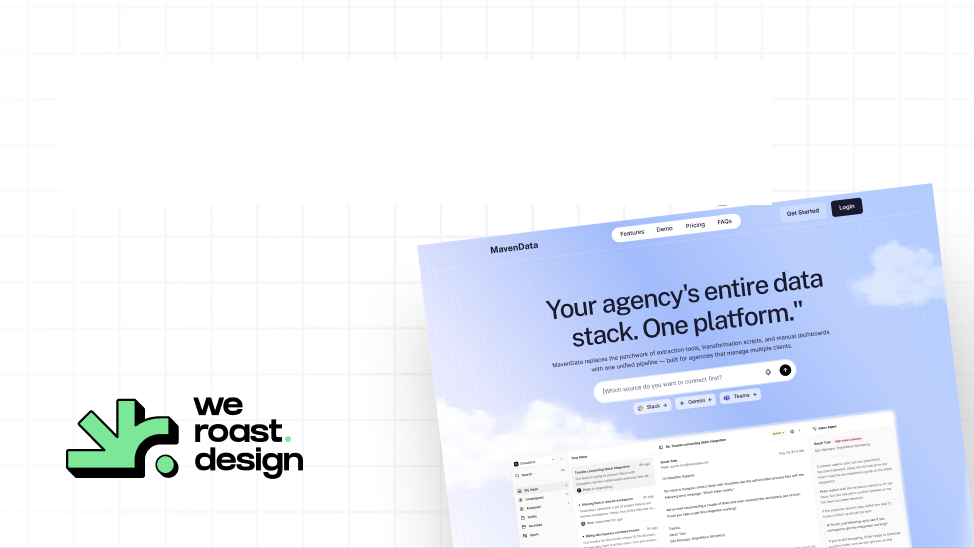
We use AI heavily in our own workflow, and it shows in the calendar. Maven Data's homepage was designed in one week (case study). The production got fast. The thinking did not get skipped.
Why is AI a tool, not a replacement?
Every generation of design tools made execution faster. Interface designers moved from Photoshop to Sketch to Figma, and each move cut the time between an idea and a finished screen. None of those tools had the idea. They made the designer with the idea faster.
AI is the next tool in that line, and the biggest jump so far. It executes in seconds what took hours. But it still executes. It answers the brief it is given; it does not decide what is worth making, what is unique about your product, or what a buyer should see first. In our view, that is the work designers were always paid for, and it is still theirs.
What are designers judged on now?
The same thing as before: creativity. The standard has not moved. What moved is everything around it. When anyone can make a competent page, a competent page stops being a reason to choose anyone. The only thing left to judge is the idea and the decisions behind it.
In our view, those decisions shape four stages of every visit to a SaaS website. AI can draft any of them. A designer decides what each one should be for your product.
- Attention: does the first screen look like it belongs to you, and no one else?
- Engagement: does the page keep a buyer reading, section after section?
- Evaluation: does it answer what a buyer needs to judge you, such as proof, product and price?
- Conversion: is the next step clear and worth taking?
What does a creative decision look like?
Kuhnic sells AI automation in a category where every second company calls itself an AI transformation partner. The claims are identical, and buyers have learned to discount them. In our experience, an AI tool asked for an AI company website returns the category's usual look. That look was the problem.
So we made a decision the category does not make. The site runs dark and monochrome, with the whiteout Kuhnic lockup on near-black over a fine grid. Outcome claims lead, such as weeks of due diligence down to an hour, and the proof, the client logos and the platform diagrams are the loudest things on the page. AI helped us execute it. The idea came from reading the category and deciding to stand apart from it. You can watch the decision being made in the Kuhnic behind-the-scenes, and read the result in the case study.
Why do niche designers have the edge?
Creativity is not random. Good ideas come from knowing the buyer, the product and what has already been tried. A designer who works in one niche carries that context into every project: what works for this kind of product, what does not, and why. They spend less time learning your world and more time on the idea.
That is why we only design for SaaS and AI companies. We have designed for hiring, energy, data, healthcare billing and AI automation software, so we know what works for your kind of product and what does not, because we keep testing it in our own design reviews. A SaaS website sells a product, so the people designing it have to understand the product. A generic agency designs the page, not the product behind it.
Be one of many, or build something unique
In our view, AI has pushed most SaaS sites toward the same look, because the tools build from what already exists. You can accept that look and be one of many, or build something that is only yours.
We call ours a Signature Design Style: the look that makes people recognize your company before they read the logo. When everyone has the same tools, a design that is only yours is a moat. That choice is a design decision, and it is made by people.
How should a SaaS team use AI with design?
Inside guardrails. Designers decide the direction once and build it into a design system. Your team then produces pages with AI, inside that system, so every new page stays on brand. Without that system, AI in the hands of non-designers produces pages that drift apart and look like everyone else's. We cover that in hire a designer or use AI.
Our Scalable Website System ships this setup: $22,981, 3.5 weeks, a design system built for Claude, Cursor and Codex, and a guide and video so your team can build new pages after we finish.
Who is Weroast?
Weroast is a design partner built only for post-PMF B2B SaaS and AI companies, from Seed to Series B. Product, website, brand and motion designers work as one team to give you a Signature Design Style and a system your team can run with AI. As of November 2026, the Signature Homepage is $9,783 and takes nine days, and the Scalable Website System is $22,981 and takes 3.5 weeks. Custom development is included in both. For product, brand and motion, a design pod starts from $35,000, with scope and timeline set on a call.
We are listed as a trusted design partner by Fletch, a product marketing firm. We do not do positioning ourselves; we work alongside partners such as Fletch, because positioning shapes design. See pricing for every package.
Hire Weroast only if
- You are a B2B SaaS or AI company past product-market fit, from Seed to Series B.
- Your positioning is clear, or you have a partner for it. We do not do positioning; we work alongside partners such as Fletch.
- You want design that becomes your company's identity, not a template that looks like everyone else's.
FAQ
Can’t find your answer?
Book a call and let’s talk
In our view, no. AI replaces a lot of production work, the way earlier tools did. It does not replace the decisions: what is unique about a product, what a page is for and what a buyer should see first. Designers who use AI execute faster; the standard they are judged by, creativity, is unchanged.
AI speeds up wireframes, variations and code, but product decisions still need someone who understands the users and the product. Designers who know one kind of product deeply are the hardest to replace, because their ideas come from context a model does not have.
Creativity, and the context that feeds it. Execution is now cheap for everyone, so the idea, the decisions and a look that belongs to one company are what a designer is judged on. Knowing one niche well makes those ideas better and faster.
Use AI to produce pages, not to decide them. Have a designer set the direction and build a design system first, then let your team ship pages with AI inside it. Low-stakes pages, such as a webinar page, can be AI from the start.
Heavily, inside our own workflow, to execute faster once the direction is decided. Maven Data's homepage was designed in one week. We also hand clients a design system built for Claude, Cursor and Codex, so their teams can keep shipping pages with AI after we finish.
Need help deciding what to build first?
Book a sprint call and we will map the right scope for your launch stage.
Book a call