
A website redesign changes one channel. A brand refresh redesigns the whole brand system, from identity and color to type and assets, while the name and positioning stay. A rebrand changes what the company is or claims, often its name. After a Series A, most B2B SaaS teams need a brand refresh and a website together.
What is the difference between a brand refresh, a rebrand and a website redesign?
They change different layers of the company, and people use the words loosely, so define them before you brief anyone.
- A website redesign changes one channel: the site's structure, pages and look. The brand underneath stays the same. It is the right job when the brand still fits and only the site lags behind the product.
- A brand refresh redesigns the whole brand system while the name and positioning stay: identity, color, typography and the assets every team uses, across the website, the product, decks and social. It is not a website refresh. A new site on an old brand system is still an old brand.
- A rebrand changes what the company is or claims: often the name, the positioning and the story, and then everything visual follows. It is the biggest job and starts with strategy, not design.
Why does a Series A change what you need?
In our experience, the brand most teams carry into a Series A was made for the seed stage: a logo, two colors and a site built to explain a first product to early adopters. The raise changes who you have to convince. Larger buyers judge you before a call. New hires judge you before they apply. The product often outgrew the story the site tells.
That gap shows up everywhere at once: the deck, the product UI, the site and LinkedIn each look slightly different, because each was made by a different person at a different time. A website redesign alone fixes one of those surfaces. A brand refresh fixes the system they all draw from, so every team stops reinventing the look.
Which one do you need? Signs for each
Start from what is actually wrong. If you cannot say which list fits, the problem is usually positioning, and that comes first.
- Website redesign: the brand still feels right, but the site explains an old product, buries proof, or does not convert. Buyers like you on calls and doubt you on the site.
- Brand refresh: the name and the message are right, but the look feels early-stage next to the companies you now compete with, and the site, the product and the decks do not look like one company.
- Rebrand: the name no longer fits, you moved into a new category, you merged, or the positioning changed. Settle the strategy first; we work alongside partners such as Fletch for positioning, because positioning shapes design.
- Brand refresh and website together: the most common case after a Series A. The refresh sets the system, and the site is the first place it ships.
What does a brand refresh include?
A brand refresh is a system, not a logo file. At Weroast it comes in two published plans, so you can see exactly what you buy before a call.
- Signature Brand Identity, from $7,800: an identity built from your positioning, product and buyers; a color system with contrast-checked pairs for light and dark backgrounds; a typography system that works across website, product and decks; core brand assets such as patterns, gradients, illustrations and product graphics; every source file in Figma.
- Scalable Brand System, $15,000: everything above, plus a brand book with do and don't examples, custom AI tools built for your team to generate on-brand social posts, and asset generation workflows built around your own use cases, so your team makes on-brand graphics without waiting on a designer.
What does it cost to do a brand refresh and a website together?
On our published plans, a brand refresh and a six-page website together cost $30,781 (Signature Brand Identity plus the Scalable Website System) or $37,981 with the full Scalable Brand System. A homepage alone is $9,783 and ships in nine days; the Scalable Website System is $22,981 and ships in 3.5 weeks, with custom development included.
Search Console shows Series A teams asking for a branding agency with a $30,000 budget. On these numbers, that budget covers a brand refresh plus a homepage and five core pages. A rebrand with a name change costs more, because naming and positioning come first. For a wider scope, such as brand, product and motion with one team, a design pod is set on a call. See pricing.
Should the brand or the website come first?
The brand system first, in the same engagement as the site. If the website is designed before the brand system exists, the site invents a look that the brand then has to match or replace. If the brand is designed alone and handed to a separate web team, decisions get lost in the handoff.
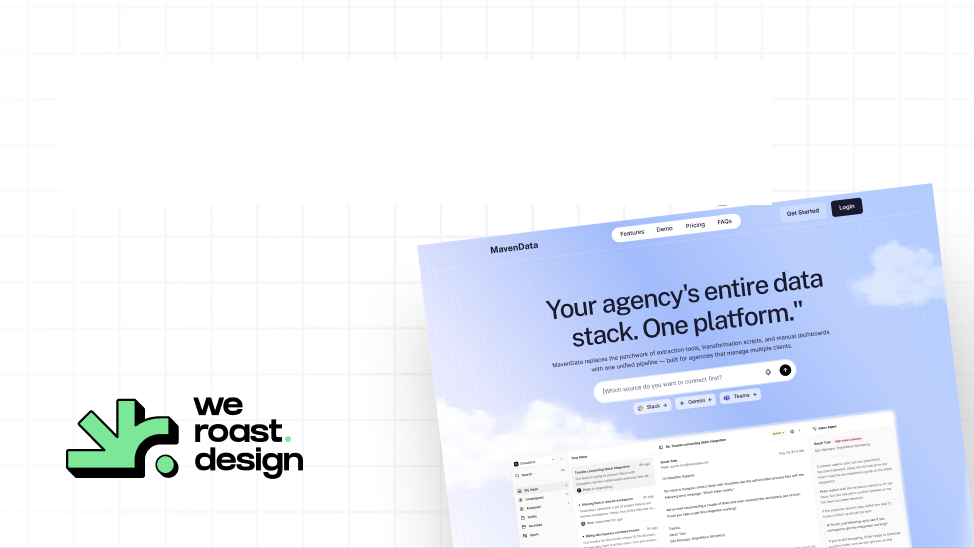
We do both with one team: the identity, color and type are decided first, and the website is the first surface built on them. The visual system on Maven Data's site, a blue-to-lavender gradient over a clean navy palette with generous whitespace, is the kind of decision that has to be made once and used everywhere. Jamie Isabel, Maven Data's founder, said it gives the site "a trustworthy, polished feel that fits our brand well."
What should a refresh keep?
Whatever buyers already recognize. A refresh is not a reset: if customers know your color or your mark, keep it and build the new system around it. The goal is that the company looks like it grew up, not like it was replaced.
In our view, three things should change: anything that looks like the category's default, anything that cannot work in both the product and the site, and anything your team keeps rebuilding by hand. When Kuhnic needed to stand apart from every other AI company, the site went dark and monochrome with the outcome claims leading, because the category's usual look was the problem.
Who is Weroast?
Weroast is a design partner built only for post-PMF B2B SaaS and AI companies, from Seed to Series B. Product, website, brand and motion designers work as one team, so the brand system and the website are decided by the same people. You can watch how a direction gets decided in the Kuhnic behind-the-scenes video.
We are listed as a trusted design partner by Fletch, a product marketing firm. We do not do positioning or naming ourselves; we work alongside partners such as Fletch.
Hire Weroast only if
- You are a B2B SaaS or AI company past product-market fit, from Seed to Series B.
- Your name and positioning are settled, or you have a partner for them. We do not do positioning or naming.
- You want a brand system your team can use on its own, not a logo file.
- You want the brand and the website made by one team, not handed between two.
FAQ
Can’t find your answer?
Book a call and let’s talk
A brand refresh redesigns the whole brand system, from identity and color to type and assets, while the name and positioning stay. A rebrand changes what the company is or claims, often including the name and positioning, and the visual system follows.
No. A website redesign changes one channel. A brand refresh changes the system every channel draws from: the website, the product, decks and social. A new website on an old brand system still looks like the old company.
At Weroast, the Signature Brand Identity starts from $7,800 and the Scalable Brand System, which adds a brand book and custom AI tools for your team, is $15,000. A brand refresh plus a six-page website costs $30,781 on our published plans.
Only if the name or positioning no longer fits. Most teams after a Series A need a brand refresh, not a rebrand: the message is right, but the look was made for the seed stage and no longer matches the buyers they now sell to.
Decide the brand system first, in the same engagement, and make the website the first surface built on it. Doing the site first means the brand later has to match it or replace it.
No. We work alongside partners such as Fletch for positioning, because positioning shapes design. We design the brand system and the website once the message is settled.
Need help deciding what to build first?
Book a sprint call and we will map the right scope for your launch stage.
Book a call