
Hire in-house when there is steady daily design work, mostly in the product. Hire a freelancer for a defined task with a clear brief. Hire an agency or design partner when you need several disciplines at once, such as website, brand and motion, or a decision you only make every few years. Most Series A teams combine one in-house designer with a partner.
What does each option actually give you?
They buy different things, so compare jobs before prices. An in-house designer gives you continuity: someone who knows the product, sits in the planning meetings and keeps the design consistent week after week. A freelancer gives you a pair of hands for a defined task. An agency or design partner gives you a team of several disciplines for a period, and decisions made by people who have made them many times.
The mistake we see most is expecting one of these to do the job of another. A single in-house hire is asked to redesign the brand, rebuild the website and design the product at once. A freelancer is handed a rebrand without a brief. An agency is asked for small weekly requests. Each fails for a predictable reason.
How do the options compare?
| Option | What it costs | Best for |
|---|---|---|
| In-house designer | A salary: the US median for web and digital interface designers was $104,000 in May 2025 (BLS), before benefits, tools and hiring time | Steady daily work, mostly in the product; keeping the system alive between big projects |
| Freelancer | Hourly or per project, set by each freelancer | A defined task with a clear brief and someone in-house to direct it |
| Design subscription | $699 to $11,999 a month on the public plans we read; Superside from a $15,000 monthly minimum | A steady flow of requests inside an existing brand |
| Agency or design partner (project) | At Weroast: $9,783 for a homepage, $22,981 for six pages and a design system, brand from $7,800, a design pod from $35,000 | Several disciplines at once, a fixed result by a date, and decisions you make every few years |
Sources: US Bureau of Labor Statistics, Occupational Outlook Handbook, Web Developers and Digital Designers (May 2025 data, read November 10, 2026); ManyPixels, Eleken and Superside pricing pages (read November 8, 2026); weroast.designpricing.
When should a SaaS company hire an in-house designer?
When there is design work every day and most of it is in the product. Product design rewards context: knowing the users, the edge cases and the engineering constraints. Someone in the room builds that context over months.
Two cautions. First, a salary is only part of the cost: add benefits, tools, the months it takes to hire, and the time a manager spends directing the work. The US median wage for web and digital interface designers was $104,000 in May 2025, according to the Bureau of Labor Statistics. Second, one person rarely covers product, website, brand and motion equally well. Hire for the discipline you need daily, and plan for the others.
When is a freelancer the right call?
When the task is defined and someone on your side can direct it: a set of illustrations in an existing style, a landing page inside an existing system, a deck template. Freelancers are fast to start and flexible, and good ones are excellent at their craft.
A freelancer struggles when the job is a decision rather than a task: a new brand direction, a homepage that has to reposition the company, a design system others will build on. Those need several disciplines and a second opinion inside the team. If you hire a freelancer for one, write the brief first; our guide to briefing a design agency works for freelancers too.
When should you hire an agency or design partner?
When you need several disciplines at once, a fixed result by a date, or a decision you make only every few years. A rebrand, a website rebuild after a raise, and a design system for the whole company are all moments where you want people who have made those decisions many times, working as one team for a defined period.
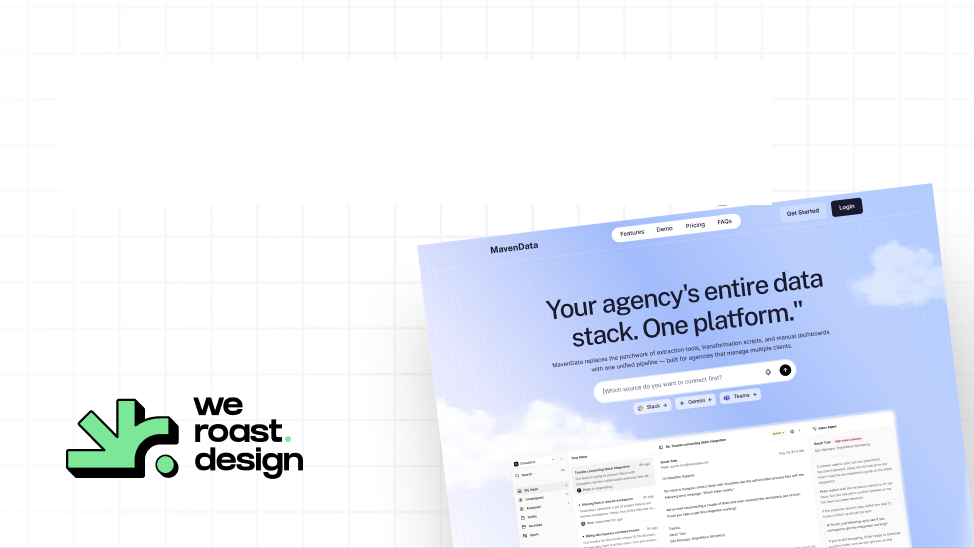
At Weroast, product, website, brand and motion designers work as one team, and the work is project-based: a fixed scope, a fixed price and an end date. The Signature Homepage is $9,783 and takes nine days; the Scalable Website System is $22,981 and takes 3.5 weeks. Maven Data's homepage was designed in one week; see the case study. Subscriptions are another model; we compare them in project-based vs subscription design.
What setup do most Series A SaaS teams end up with?
In our experience, a combination: one in-house designer, usually product-focused, plus a design partner for the big moments. The partner sets the direction and builds the system: the brand, the website and a design system. The in-house designer and the marketing team then extend it day to day, increasingly with AI tools inside that system.
This is why our Scalable Website System includes a design system built for Claude, Cursor and Codex, plus a guide and video for your team. Michael Lock, PMM at Clarity RCM, described what came back as "a complete system in Figma plus a 25-page site architecture." The system is what lets a small in-house team keep shipping on-brand work after we finish.
Who is Weroast?
Weroast is a design partner built only for post-PMF B2B SaaS and AI companies, from Seed to Series B. We work as an embedded partner too, with custom plans for ongoing, project-based collaboration. You can watch how we make decisions in the Kuhnic behind-the-scenes video. See pricing for every plan.
We are listed as a trusted design partner by Fletch, a product marketing firm. We do not do positioning ourselves; we work alongside partners such as Fletch.
Hire Weroast only if
- You need several disciplines at once: website, brand, product or motion.
- You want a fixed scope, a fixed price and an end date, and a system your team can run after.
- Your positioning is clear, or you have a partner for it. We do not do positioning.
- You are a B2B SaaS or AI company past product-market fit, from Seed to Series B.
Sources, checked November 2026
- US Bureau of Labor Statistics, Occupational Outlook Handbook: Web Developers and Digital Designers (May 2025 data, read November 10, 2026)
- ManyPixels pricing page (read November 8, 2026)
- Eleken pricing page (read November 8, 2026)
- Superside pricing page (read November 8, 2026)
- Weroast pricing page (November 10, 2026)
FAQ
Can’t find your answer?
Book a call and let’s talk
Over a year of steady work, an in-house designer usually costs less per hour of design. For a defined project such as a website or brand, an agency is often cheaper overall, because you pay for a result with several disciplines and no hiring time. Compare the cost of the outcome, not the hourly rate.
When there is design work every day, usually once the product team is shipping weekly and design has become a bottleneck. Before that, a partner for the big moments and freelancers for defined tasks are usually a better use of money.
Rarely all three equally well, and not all at once. Hire for the discipline you need daily, usually product, and bring in a team for the website, brand and motion when those moments come.
Only with a clear brief and someone in-house to direct the work. A rebrand is a set of decisions across identity, color, type and assets, and it usually benefits from a team with several disciplines.
The US Bureau of Labor Statistics reports a median annual wage of $104,000 for web and digital interface designers in May 2025. Add benefits, tools, recruiting time and management time for the full cost.
Need help deciding what to build first?
Book a sprint call and we will map the right scope for your launch stage.
Book a call