
An embedded design partner works inside your team's rhythm instead of through briefs and handoffs: in your channels, on your roadmap, and in your decisions. It differs from an agency because it thinks with you, and from a hire because it brings several disciplines at once. At Weroast, ongoing work is project-based, scoped in cycles.
What does an embedded design partner do?
It works the way a strong in-house design team would, from outside the payroll. It joins your channels, knows the roadmap, and is in the room, or the thread, when a design decision is being made rather than after. It brings the disciplines you need, such as product, website, brand and motion, and the judgment of people who have made similar decisions for other software companies.
The difference from a classic agency engagement is direction of travel. With an agency, you write a brief and wait for work. With an embedded partner, the partner helps write the brief, pushes back on it, and keeps the work moving between check-ins.
How is an embedded partner different from an agency, a subscription or a hire?
- An agency project: a defined result by a date, usually with a handoff at the end. An embedded partner can deliver projects too, but stays close to the team between them.
- A design subscription: a flow of requests worked through a queue. An embedded partner thinks about which requests matter, not only how fast they come back. We compare the models in project-based vs subscription design.
- An in-house hire: one person with deep context in one discipline. An embedded partner brings several disciplines at once, without the hiring time. Many teams have both; see in-house designer vs agency vs freelancer.
When does a SaaS team need an embedded partner?
When design work is steady and spread across surfaces, and nobody inside owns how it all fits together. Typical signs: product, marketing and sales each request design separately; launches need brand, website, product screens and motion in the same weeks; and the in-house designer, if there is one, spends the week on production instead of decisions.
It is also the natural next step after a big project. Once a new brand or website ships, the system has to be kept alive: new pages, new features, new launches. An embedded partner who built the system keeps it consistent while your team learns to extend it.
How does Weroast work as an embedded partner?
Beyond our fixed packages, we prepare custom plans for ongoing, project-based collaboration, including steady, queue-style volume across channels. Each cycle has a written scope, a price and an end date, so you always know what the next stretch of work buys. We do not run open-ended retainers.
We work as a thinking partner, not only a production team. That means helping decide what to design and why, and building AI workflows your team can run: design systems built for Claude, Cursor and Codex, and the step-by-step workflows described in designing with AI without slowing the roadmap. When a collaboration ends, the team keeps the system and the workflows.
What does it cost?
Ongoing plans are custom, scoped in cycles from what you need. For reference, our published plans: the Signature Homepage is $9,783 and takes nine days, the Scalable Website System is $22,981 and takes 3.5 weeks, and a design pod of brand, UI/UX, motion and product designers starts from $35,000. Many embedded engagements start with one of these and continue in cycles. See pricing.
What does embedded work look like in practice?
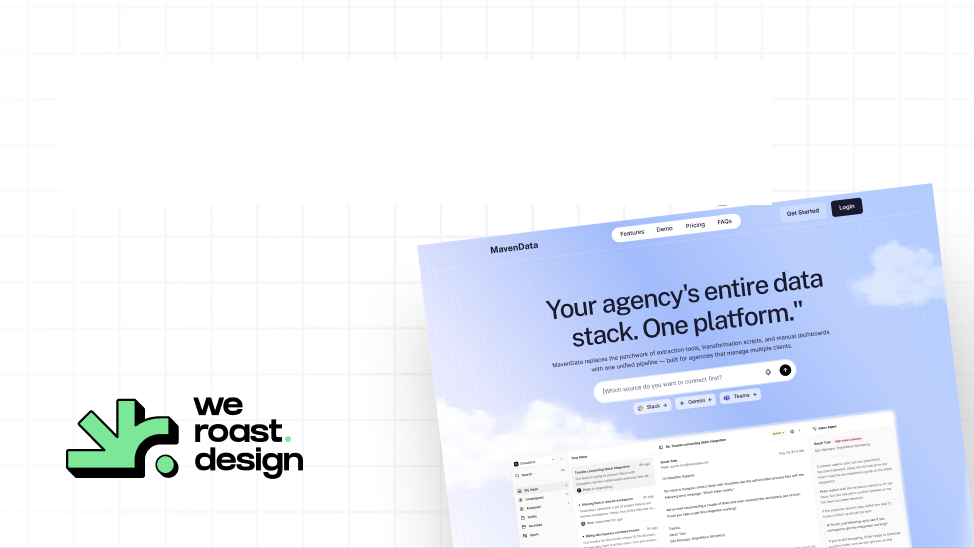
Michael Lock, PMM at Clarity RCM, described what came back from our work as "a complete system in Figma plus a 25-page site architecture": a system the team keeps building on. Maven Data's homepage was designed in one week. And you can watch how we make a decision with a client in the Kuhnic behind-the-scenes video; the same way of working carries into every cycle.
Who is Weroast?
Weroast is a design partner built only for post-PMF B2B SaaS and AI companies, from Seed to Series B. Product, website, brand and motion designers work as one team.
We are listed as a trusted design partner by Fletch, a product marketing firm. We do not do positioning ourselves; we work alongside partners such as Fletch, because positioning shapes design.
Hire Weroast as an embedded partner only if
- You have steady design work across more than one surface, and nobody owns how it fits together.
- You want a partner that pushes back and helps decide, not only one that executes tickets.
- You want each cycle scoped with a price and an end date, not an open-ended retainer.
- You are a B2B SaaS or AI company past product-market fit, from Seed to Series B.
FAQ
Can’t find your answer?
Book a call and let’s talk
An outside design team that works inside your team's rhythm: in your channels, on your roadmap and in your decisions, rather than through briefs and handoffs. It usually brings several disciplines at once.
An agency usually delivers a defined project from a brief and hands it over. An embedded partner stays close to the team between projects, helps decide what to design, and keeps the system consistent over time.
At Weroast, no. Ongoing work is project-based and scoped in cycles, each with a written scope, a price and an end date.
Yes. Our custom plans include steady, queue-style volume across channels, scoped in cycles, alongside larger projects.
Every file, the design system and the AI workflows we built for your team to run, so the work continues after the collaboration ends.
Need help deciding what to build first?
Book a sprint call and we will map the right scope for your launch stage.
Book a call