
Start where the business is losing most. If buyers doubt you before a call, start with the website. If the website, product and decks look like different companies, start with the brand system, then the website on top of it. If users struggle or churn after buying, start with the product. When you change the look, decide the brand first.
How do you decide what to design first?
Find where the business is losing most, and design there first. Each kind of design work fixes a different leak. The website wins or loses buyers before they talk to you. The brand system decides whether everything you make looks like one company. The product decides whether users stay after they buy.
Look at your own numbers before anyone's opinion: where deals stall, what sales spends the first call explaining, what support tickets are about, and how the site, product and decks look side by side. The table below maps the common situations to a starting point. Our pipeline signs guide helps if you suspect the website.
What should you design first, by situation?
| Your situation | Start with | Why |
|---|---|---|
| Buyers like you on calls but doubt you on the site | Website | The site is where buyers judge you first; fix the most-seen surface |
| Raising soon, or just raised | Website, on a refreshed brand if the look is early-stage | Investors, hires and larger buyers all check the site |
| Site, product and decks look like different companies | Brand system, then the website | One system stops every team reinventing the look |
| Moving upmarket to larger buyers | Brand system and website together | The look has to match the price and the buyer |
| Users struggle, churn or need support to do basic tasks | Product | Retention is won inside the product, not on the site |
| Demos lose deals the website won | Product, then align the website to it | Buyers feel the gap between the promise and the product |
| Before product-market fit | Product, with a simple site | The message will change; do not pay to make it look finished |
Why should the brand come before the website when the look changes?
Because the website is built from the brand: its colors, type, imagery and assets. If you redesign the website first and the brand later, the site invents a look the brand then has to match or replace, and you pay for the website twice.
This does not mean months of brand work before anything ships. In our experience, the fastest path is one engagement where the brand system is decided first and the website is the first surface built on it, by the same team. If your brand still fits and only the site lags, skip the brand work and redesign the site. We cover the difference in brand refresh vs rebrand vs website redesign.
When does product design come first?
When the leak is after the sale. If users need support to do basic tasks, if onboarding loses people, or if demos lose deals the website won, a better website will bring in more buyers to the same problem. Fix the product first, then align the website to it, because the site should show the product as it really is.
Before product-market fit, the product almost always comes first. The message will change as you learn, and a polished website around a changing message is money spent twice. A simple, clear site is enough; see our pre-PMF website guide.
Can you do all three at once?
Yes, with one team and a clear order. Brand decisions come first because both the website and the product draw from them. The website usually ships next because it is the most-seen surface. Product work runs in parallel or follows, using the same type, color and components, so the demo matches the homepage. The risk with three separate vendors is three looks; the fix is one design system everyone builds on.
At Weroast, a design pod of brand, UI/UX, motion and product designers works this way, from $35,000, with scope and timeline set on a call. Clarity RCM is an example of a website and design system built together; Michael Lock, PMM, described what came back as "a complete system in Figma plus a 25-page site architecture."
What does each cost?
On our published plans, as of November 2026. Prices for other companies vary by model; our cost guide compares them.
- Website: the Signature Homepage is $9,783 and takes nine days; the Scalable Website System is $22,981 for a homepage plus five pages and a design system, in 3.5 weeks. Custom development is included in both.
- Brand: the Signature Brand Identity starts from $7,800; the Scalable Brand System is $15,000 and adds a brand book and custom AI tools for your team.
- Product: Product design is fully custom. We price it from your problem, your context and what it takes to solve it.
- All three with one team: a design pod from $35,000.
Who is Weroast?
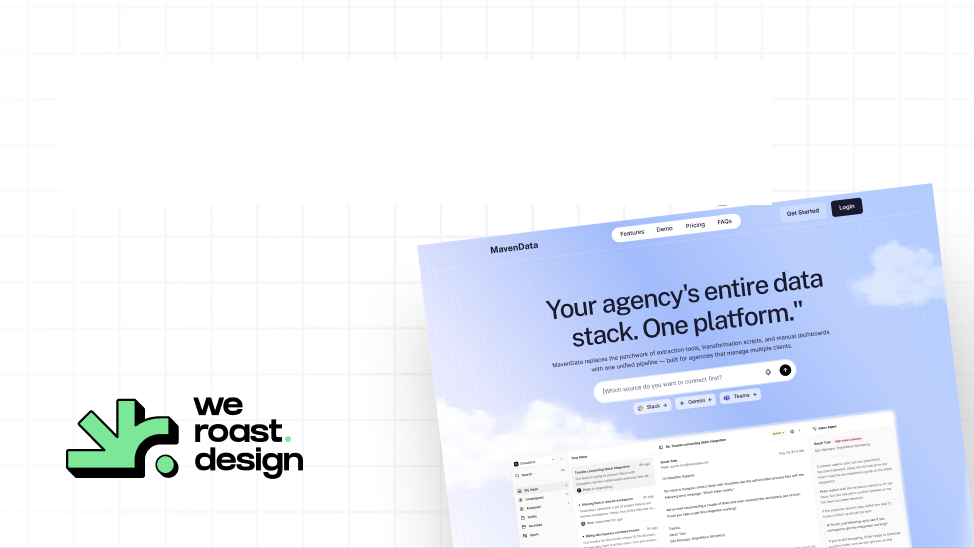
Weroast is a design partner built only for post-PMF B2B SaaS and AI companies, from Seed to Series B. Product, website, brand and motion designers work as one team, so the order of work is decided once, not negotiated between vendors. Maven Data's homepage was designed in one week; see the case study, and watch how a direction is decided in the Kuhnic behind-the-scenes video. See pricing.
We are listed as a trusted design partner by Fletch, a product marketing firm. We do not do positioning ourselves; we work alongside partners such as Fletch.
Hire Weroast only if
- You need more than one kind of design work and want one team to sequence it.
- Your positioning is clear, or you have a partner for it. We do not do positioning.
- You are a B2B SaaS or AI company past product-market fit, from Seed to Series B.
FAQ
Can’t find your answer?
Book a call and let’s talk
If the look is changing, decide the brand system first and build the website on it in the same engagement. If the brand still fits and only the site lags behind the product, redesign the website alone.
Start where you lose most. If buyers doubt you before a call, start with the website. If users struggle or churn after buying, or demos lose deals the site won, start with the product, then align the site to it.
Yes, with one team and one design system. Brand decisions come first, the website usually ships next, and product work uses the same type, color and components so the demo matches the homepage.
The product, with a simple, clear website. The message will change as you find fit, so a polished site or brand built now will likely be redone.
On our published plans, the Signature Brand Identity starts from $7,800 and the Scalable Website System is $22,981. For brand, website, product and motion with one team, a design pod starts from $35,000.
Need help deciding what to build first?
Book a sprint call and we will map the right scope for your launch stage.
Book a call