
Spend on design where the stage needs it. Before product-market fit, keep the website simple and put design into the product. After fit, the website and brand start winning or losing deals, so fund a real site and a brand system. By Series A to B, keep design alive with a system, an in-house designer and a partner for big moments.
How should you think about a design budget?
As a sequence of bets, not a percentage. Each stage of a SaaS company has one place where design pays back most, and the mistake is funding the next stage's design too early or the current stage's too late. A polished brand before product-market fit is money spent on a message that will change. A template website after a Series A is a discount every buyer applies to you.
The playbook below is our view, from working only with B2B SaaS and AI companies. Adjust it to how you sell: if buyers meet the site before they meet you, move website spend earlier.
What should each stage fund?
| Stage | Fund first | What it buys at Weroast prices |
|---|---|---|
| Before product-market fit | Product usability; a simple, clear site | Weroast is built for post-PMF companies; keep spend low while the message changes |
| Seed, after fit | A homepage that sells, on a settled message | Signature Homepage: $9,783, nine days |
| Seed to Series A | A brand system and a core website your team can extend | Signature Brand Identity from $7,800; Scalable Website System $22,981, 3.5 weeks |
| Series A to B | One system across product, site and brand; ongoing capacity | Scalable Brand System $15,000; design pod from $35,000; an in-house designer |
Prices: weroast.designpricing, November 10, 2026. Product design is priced per engagement.
Before product-market fit: what is worth paying for?
Product usability first, because retention tells you whether you have fit and bad UX hides the answer. On the marketing side, a simple, clear website with a strong headline is enough; the message will change as you learn. Use templates and AI tools here without guilt, and save the brand system for when you know what it should say. Our pre-PMF website guide covers the minimum.
Seed, after fit: what changes?
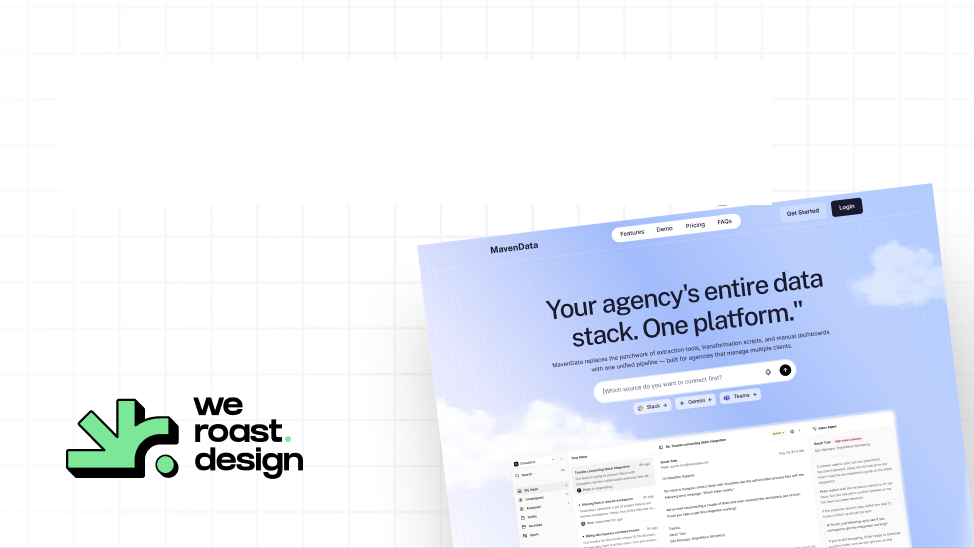
Now the website starts selling. Buyers who do not know the founder land on the homepage, and it decides whether they book a call. The highest-return line is usually one excellent homepage on a settled message: our Signature Homepage is $9,783 and takes nine days, with motion and custom development included. Maven Data's homepage was designed in one week.
Seed to Series A: when do brand and system pay off?
When the company starts producing a lot: more pages, more decks, more launches, more people making them. Without a system, each new piece reinvents the look and the brand drifts. Fund a brand system and a core website together: the Signature Brand Identity from $7,800 and the Scalable Website System at $22,981, a homepage plus five pages and a design system built for Claude, Cursor and Codex. The system is what lets a small team keep shipping on-brand work.
Series A to B: how do you keep design alive?
With three lines. An in-house designer for daily product work; the US median wage for web and digital interface designers was $104,000 in May 2025, according to the Bureau of Labor Statistics, before benefits and tools. A design system that the in-house designer, marketing and AI tools all build on. And a partner for the big moments, such as a brand refresh, a launch or a new product line: our Scalable Brand System is $15,000, and a design pod of brand, UI/UX, motion and product designers starts from $35,000. Product design is fully custom. We price it from your problem, your context and what it takes to solve it.
We cover how the hire and the partner split the work in in-house designer vs agency vs freelancer.
How do you justify the budget to a board or a CFO?
- Tie it to one pipeline number: demo requests, win rate in evaluation, or average deal size.
- Show the leak with your own data: sales-call corrections, scroll depth, demo page visits against requests.
- Price the alternative: discounts given because the site looked smaller than the company, or a second redesign within a year.
- Fix the scope, price and end date in writing, so the spend is a project, not an open line.
- Set the measurement date before launch: four to six weeks after, compared with the old site.
Who is Weroast?
Weroast is a design partner built only for post-PMF B2B SaaS and AI companies, from Seed to Series B. Every plan is project-based, with a fixed scope, a fixed price and an end date. You can watch how we decide in the Kuhnic behind-the-scenes video. See pricing.
We are listed as a trusted design partner by Fletch, a product marketing firm. We do not do positioning ourselves; we work alongside partners such as Fletch.
Hire Weroast only if
- You are past product-market fit, from Seed to Series B.
- You want design spend as fixed projects with prices and end dates, not open lines.
- Your positioning is clear, or you have a partner for it. We do not do positioning.
Sources, checked November 2026
FAQ
Can’t find your answer?
Book a call and let’s talk
Before product-market fit, as little as a clear, simple site needs. After fit, enough for a site that sells on its own: at Weroast, a homepage is $9,783 and a homepage plus five pages with a design system is $22,981.
After product-market fit, when the message is settled and the company starts producing a lot of material. Before that, the brand would have to change with the message.
Usually both: an in-house designer for daily product work, and a partner for big moments such as a brand refresh or a new website, with one design system they both use.
Pick one pipeline number before launch, such as demo requests or win rate in evaluation, and compare it four to six weeks after launch with the old site, alongside sales-call notes.
Need help deciding what to build first?
Book a sprint call and we will map the right scope for your launch stage.
Book a call